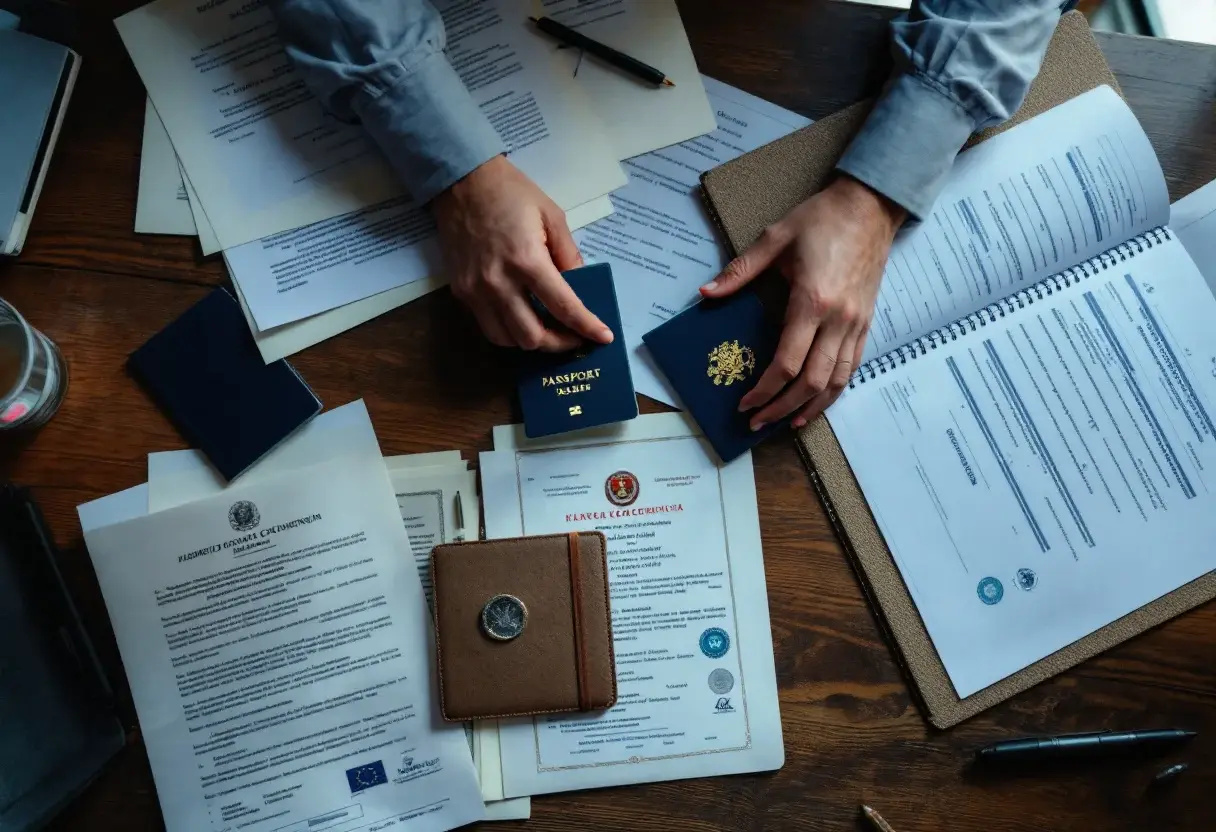
A point-by-point comparison
| Parameter | Apostille | Consular legalisation |
|---|---|---|
| When it applies | Both countries are in the 1961 Hague Convention | At least one country outside the convention |
| How many stages of appeal | One | Three to four in sequence |
| Who issues the stamp | Competent authority of the country that issued the document | Ministry of Justice → Ministry of Foreign Affairs → destination country consulate |
| Duration | Days or weeks | Weeks, often months |
| Where it applies | In all convention countries | Only in the country whose consulate certified it |
| If there are several destination countries | A single apostille is sufficient | A separate procedure for each country |
| Cost | A single fee | A government fee at each stage, plus translations |
How to figure out what you need
There is exactly one approach: check who issued the document and where you are taking it. The procedure is determined by that combination — not by the type of document, or by what someone said in a relocation chat.
There is also a third, often overlooked option that is actually the most convenient: a number of countries have bilateral legal assistance treaties under which documents are accepted without any authentication at all — a translation is sufficient. This is worth checking first: a procedure you can skip is cheaper than any other.
- Both countries are in the Hague Convention — apostille
- One of the countries outside the convention — consular legalisation
- A legal assistance treaty exists between the two countries — often neither apostille nor certified translation is required
- The document was issued by a third country — the procedure must be completed there, not at your place of residence
A sworn translation is a third thing entirely, not part of the procedure
An apostille and legalisation confirm the authenticity of the signature and seal on a document. They say nothing about the language in which the document is written. That is why a translation is almost always needed as well — and almost always not just any translation.
Most countries accept a translation made by a sworn (court-certified) translator accredited in that specific country. A translation notarised in the country of departure is often not accepted at all — one of the most frustrating reasons for redoing documents, because it only comes to light at the submission window.
- The usual order is: apostille or legalisation first, then translation — together with the stamp
- The translator must be accredited in the destination country, not in the country of issue
- Translations with notarised certification from your home country are not accepted everywhere
- The spelling of your first and last name must match across all documents, letter for letter
Where a solid application package most often falls apart
- The apostille was placed on a copy when the original was required — or the other way around
- The criminal record certificate was obtained in advance and has expired by the time of submission: it has a short validity period
- The translation was done before the apostille, leaving the apostille stamp untranslated
- The name in translation is spelled differently from the one in the international passport
- If the documents were legalised for one country but you decide to apply in another, the entire procedure will have to be repeated from scratch
How long does this take in practice
An apostille in most cases takes anywhere from a few days to several weeks — it depends on the authority and its workload. Consular legalisation almost always takes longer: there are more stages, each with its own queue, and the entire process is limited by the speed of the slowest step.
Build your document package backwards from the filing date, not forwards from today. Factor in expiry dates separately: criminal record certificates and bank statements only last a few months, so part of the package has to be prepared last to avoid it expiring before you submit.
Next come the documents themselves
An apostille and translations are almost never needed in isolation: they are gathered as part of an application for status, study, or marriage. It is cheaper and faster when documents are prepared as a package for a specific purpose.
Frequently asked questions
How does an apostille differ from consular legalisation?
An apostille is a single stamp from the competent authority of the country that issued the document; it is valid in all countries party to the 1961 Hague Convention. Consular legalisation is a chain of certifications — typically through the Ministry of Justice, the Ministry of Foreign Affairs, and the consulate of the destination country — required when at least one of the countries is not party to the Convention, and it is valid only in the country whose consulate completed the process.
How do I find out what I need in my case — apostille or legalisation?
Check two things: who issued the document and where you are submitting it. If both countries are parties to the Hague Convention — an apostille will do. If at least one is not — full legalisation is required. Some countries have bilateral legal assistance treaties under which neither is needed.
Do you need a translation if you already have an apostille?
Almost always, yes. An apostille confirms the authenticity of a signature and seal but does not translate the document. Most countries require a translation by a sworn translator accredited in the country of application, and a notarised translation from the country of departure is often not accepted.
Can an apostille be obtained in a country other than the one that issued the document?
No. An apostille is issued by the competent authority of the country where the document was issued. If you have already left, you will need a power of attorney and someone on the ground — factor in this lead time from the start.
What to do if a document is needed for several countries at once?
If all countries involved are signatories to the Hague Convention, a single apostille is sufficient. Consular legalisation does not work the same way: it is valid only for the country whose consulate completed it, and the procedure must be repeated separately for each additional country.
Verified 8/3/2026. Procedure varies by country — the general principle is here, your specific case will be reviewed separately.