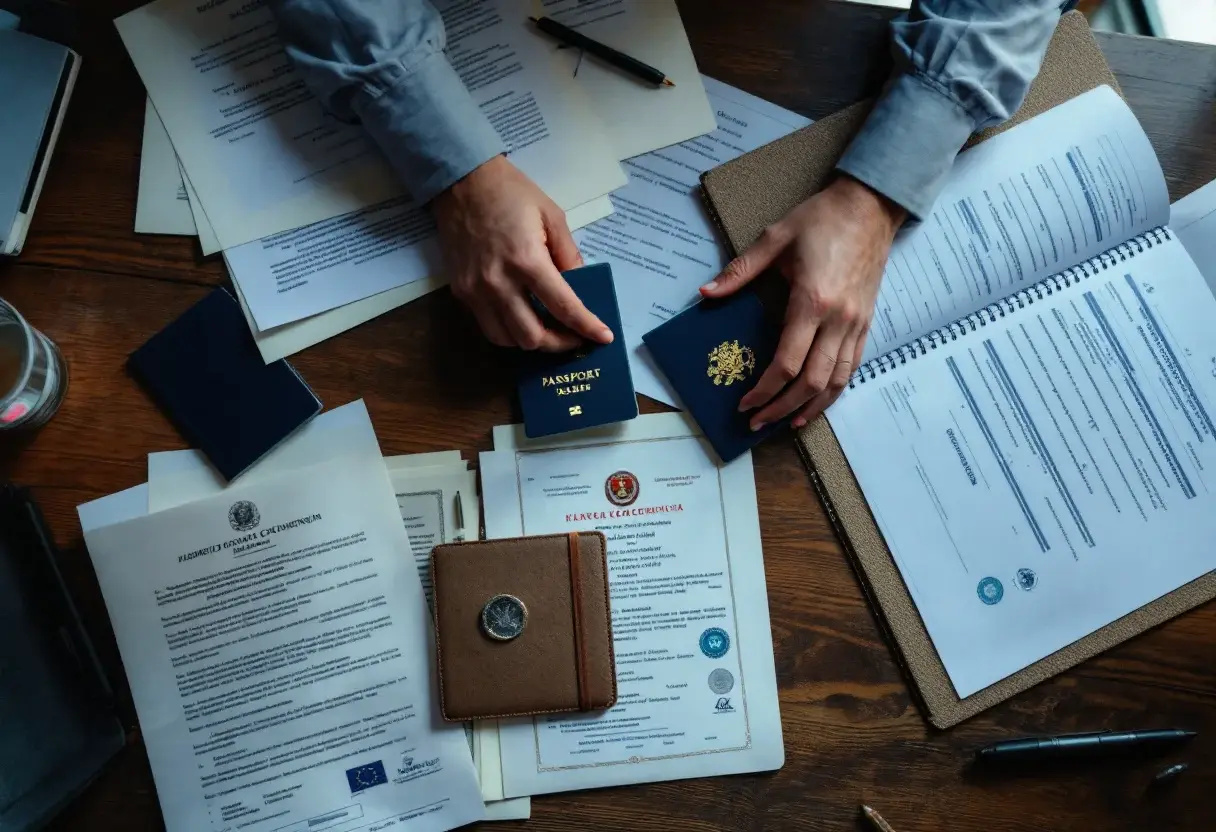
Complete list: what is usually required to be legalised
The required documents depend on the grounds, but the set of documents that go through through legalisation and translation, almost always the same:
| Document | What is done with it | What to look for |
|---|---|---|
| Criminal record certificate | Apostille or legalisation + certified translation | Validity period — often three months from the date of submission |
| Birth certificate | Apostille or legalisation + certified translation | Names must match the passport |
| Marriage or divorce certificate | Apostille or legalisation + certified translation | For divorce — entry into force of the decision |
| School-leaving certificate and transcript | Apostille + translation, sometimes nostrification | A transcript is almost always required |
| University degree and transcript | Apostille + translation; for work purposes — nostrification | Regulated professions = mandatory recognition |
| Medical certificate | Translation, and sometimes legalisation | The wording must meet the requirements of the destination country |
| Consent for the child to travel, guardianship documents | Notarised + apostille + translation | Valid for a limited time |
| Powers of attorney | Notarised + apostille + translation | A power of attorney scoped to a specific action |
| Income statements, bank statements, tax returns | Translation, and sometimes legalisation | A history matters, not just a balance |
Apostille or consular legalisation
These are not two ways of doing the same thing — the choice has already been made for you whether both countries are party to the 1961 Hague Convention.
| Apostille | Consular legalisation | |
|---|---|---|
| When it applies | Both countries are in the Hague Convention | At least one country outside the convention |
| What it looks like | A single stamp or app in the prescribed form | The legalisation chain: notary → ministries → consulate |
| Where it is done | In the country that issued the document | In the issuing country, with the final step at the consulate of the destination country |
| How long it takes | Usually days or weeks | Usually weeks, sometimes longer |
| Can one replace the other? | No. This is determined by the convention, not by convenience. | |
How to check what you needTwo questions: which country issued the document and to which country you are you are submitting. If both countries are in the convention — apostille. If not — legalisation. The competent authority for an apostille depends on the type of document: for documents from civil registry offices, educational institutions, and criminal record certificates varies.
Nostrification: recognition of qualifications
An apostille confirms that a document is genuine. It does not confirm that your degree is equivalent to a local one — that is a separate recognition procedure (nostrification, homologación, equivalencia).
- For enrollment recognition of the previous status is usually required educational level: school-leaving certificate for a bachelor’s degree, a diploma for master’s programme. The procedure runs in parallel with the document submission, and its timeline does not align with the admissions cycle — you need to start well in advance.
- For work in a regulated profession — doctor, lawyer, engineer, teacher, architect — recognition is mandatory, and often requires additional exams or practical training. Without it, working in specialisation is not allowed, even with a work residence permit.
- For all other professions formal recognition is often not required at all: a diploma with translation is sufficient for the employer. It is worth clarifying this before starting a lengthy procedure.
About timelines and requirements by countryWhat exactly is accepted, which authority issues the apostille, and whether one is required diploma recognition — determined by the country of application and document type, and rules change. We do not publish a country-by-country table precisely because it goes out of date faster than it can be read: let us tell you personally of documents and country.
For Spain, individual steps can already be ordered at a fixed price — apostille, criminal record certificates, duplicate documents.