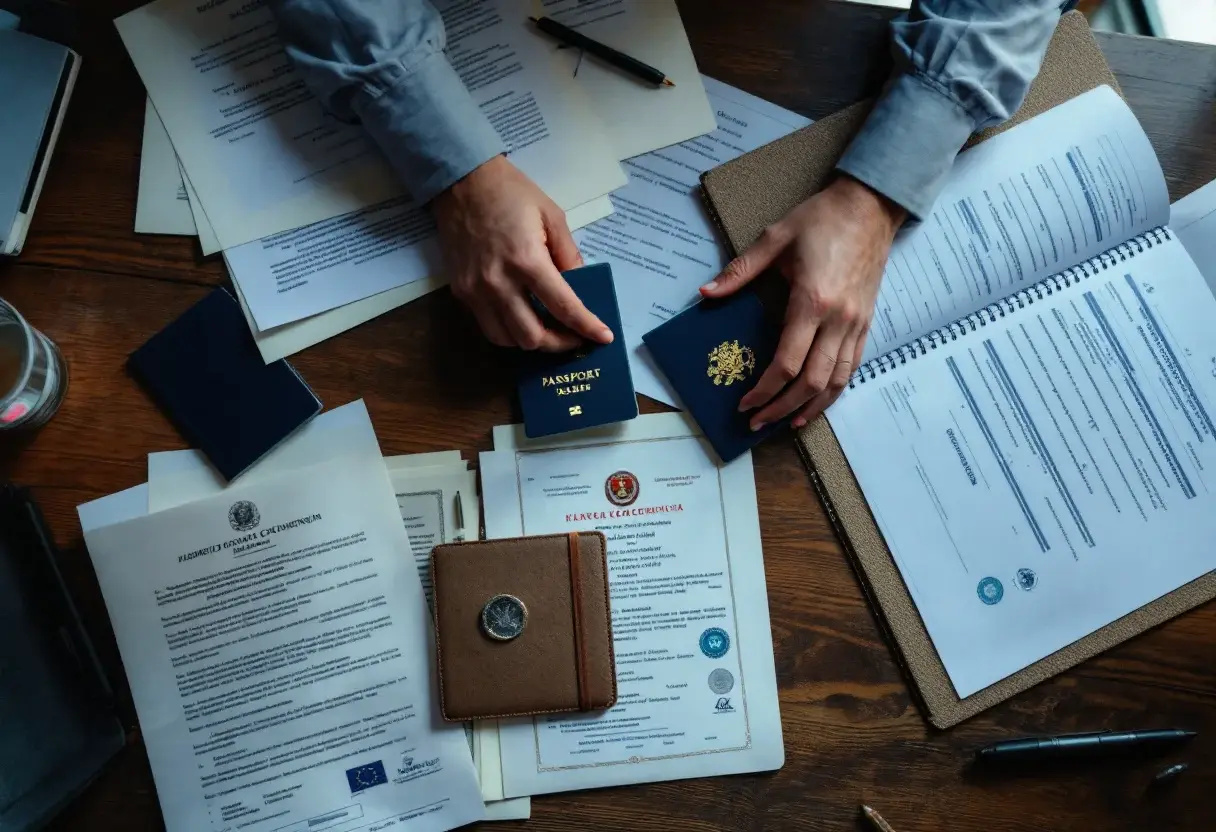
A point-by-point comparison
| Parameter | Certified translation | Certified translation |
|---|---|---|
| Who is responsible for the content | translator certified by Spain’s Ministry of Foreign Affairs | a translator whose signature was notarized |
| What exactly is certified | accuracy and faithfulness of the translation — certified by signature and stamp | under the rules of the country where the notary operates |
| Official status in Spain | yes, explicitly named in the regulations | absent from the list of certified translations |
| Is legalisation required | no, the regulations exempt this directly | depends on the country and the procedure |
| Stamp | strict format: name, languages, number — nothing else | execution in accordance with the notary’s country rules |
| Where to find a service provider | public list on the Spanish Ministry of Foreign Affairs website | at a notary or translation bureau |
| Price | set freely, no fixed rate | at the notary’s country rates |
Closed list: what actually counts as an official translation
The regulations of the Spanish Ministry of Foreign Affairs’ Interpretation Office, approved by Royal Decree 724/2020, list the official translations between foreign languages and Spanish and vice versa. The list is exhaustive and contains four items.
The first: translations certified by the Ministry of Foreign Affairs’ own Interpreting Department. The second: translations produced by a holder of the title of sworn translator or sworn interpreter, conferred by the MFA. The third: translations produced or adopted as their own by a Spanish diplomatic mission or consular post abroad, where they relate to a foreign public document forming part of a case initiated or filed at that same post and to be resolved by the Spanish administration; such translations must be accompanied by a certificate to that effect. The fourth: translations produced by a foreign career diplomatic mission or consular post in Spain, where they concern the text of that country’s legislation or a public document from that country.
As a separate point: translations are also considered official when that status is conferred on them by applicable European Union law.
Notarised certification of a translation made in a third country is not on that list. This does not mean such a translation is ’bad’ — it simply has no official standing before Spanish authorities.
- Interpreting Division of the Spanish Ministry of Foreign Affairs
- Sworn translator accredited by the Ministry of Foreign Affairs
- Spanish consulate abroad — with certificate
- Foreign consulate in Spain handling personal documents — using their home country’s documents
What a sworn translator actually does
The regulation describes this precisely: sworn translators certify the faithfulness and accuracy of their work with their signature and seal.
The stamp requirements are strict. It must state — at minimum in Spanish, exclusively, with no additional text or symbols of any kind — three things: the translator’s first and last name, the language or languages for which they hold the title, and their registration number. No logos, addresses or phone numbers.
The declaration text is also set by the template in the annex to the regulations: the translator, holding a qualification issued by the Ministry of Foreign Affairs, certifies that the preceding text is a true and accurate translation of a document originally written in a specified language, with the place and date indicated.
A condition that is often missed: to verify the authenticity of the original, a copy of that original — stamped and dated on every page — must accompany the translation. A sworn translation is therefore always a set comprising the translation and a certified copy of the source document, not a standalone sheet.
- The signature and stamp certify accuracy and correctness
- Only the name, languages, and number are printed — no symbols or additions
- Declaration text following the template in the annex to the regulations
- A copy of the original with a stamp and date on each page is attached to the translation
Exemption from legalisation — and why it matters
The regulation states clearly: the title of sworn translator grants the right to practise regardless of place of residence, and official translations made by a sworn translator that must carry legal force before Spanish public administrations are exempt from legalisation.
This leads to two practical consequences.
First: a certified translation does not need to be apostilled. The apostille is placed on the original document in the country that issued it — not on the certified translation.
Second: a sworn translator does not have to be based in Spain. The credential is valid regardless of where the holder lives, and signature and seal verification for those living abroad is handled through consular offices. This means translations can be done without waiting to relocate.
Where to find a translator and how much it costs
The Interpreting Division periodically publishes a list of all sworn translators and interpreters awarded the title by the Ministry of Foreign Affairs, along with their language pairs. Contact details and an indication of whether the person is currently in active practice are also published — if the individual has chosen to share them.
The list is publicly available on the Ministry of Foreign Affairs website. It is worth checking your provider against it before making any payment: the title is granted by the ministry, and outside that list it does not exist.
The regulations do not set prices at all: sworn translators are free to determine their own fees. There is no standard rate, and variation between providers is normal — not a sign of anything dishonest.
The sworn-translator certificate is a separate matter: the authority issues it upon application and payment of the relevant fees.
- Public list on the Spanish Ministry of Foreign Affairs website
- The list contains the name, languages, and, at the interpreter’s discretion, contact details
- There is no fixed rate: the translator sets the price freely
Three alternatives to a sworn translator
If finding a sworn translator for your language is difficult, the regulations allow three legitimate options — and few people know about them.
First: translation certified by the Ministry of Foreign Affairs’ own Interpretation Department. Second: a translation made or adopted as its own by a Spanish diplomatic mission or consulate abroad — valid when the document is part of a case opened at that same mission and accompanied by the relevant certificate. Third: a translation made by a foreign career consulate in Spain, provided it concerns the text of that country’s own law or an official document from it.
All three carry the same official weight as a sworn translation. But each has its own conditions of use, and none can substitute for a sworn translation in a standard application — the consular route works only within its own procedure.
What about a certified translation
A certified translation is a common and workable arrangement, but it operates under the law of the country where the notary practises, and what exactly the notary certifies is governed by that country’s law — not Spanish law.
Spanish authorities care about something else: the official status of a translation is defined by a closed list, and a notarial certification from a third country is not on it. A notarially certified translation therefore does not become official in Spain — regardless of its quality.
This leads to a straightforward rule for assembling your document package. Apostille or consular legalisation — in the country that issued the document, on the original. Translation — by a sworn translator from the Spanish Ministry of Foreign Affairs list. A notary in this chain serves a different purpose: for powers of attorney and declarations, not for translating documents you submit to Spanish authorities.
If the translation has already been notarised, only the translation will need to be redone: the apostille on the original remains valid and does not need to be reaffixed.
Next: documents
Translation is just one of the three stages of document legalisation. Companion guides explain the other two and how they apply to specific applications.
Frequently asked questions
Will Spain accept a notarially certified translation?
The official status of translations in Spain is defined by a closed list in the regulations: the Ministry of Foreign Affairs Interpreting Office, a sworn translator holding an MFA title, a Spanish consulate abroad, or a foreign career consulate in Spain. Notarised certification from a third country does not appear on this list.
Does a certified translation need to be apostilled?
No. The regulation explicitly exempts certified translations by sworn translators that are to have legal effect before Spanish authorities. The apostille is affixed to the original document in the country where it was issued.
Can a sworn translator work from outside Spain?
Yes. The qualification entitles the holder to practise regardless of their place of residence, and signature and seal verification for those working abroad is handled through consular offices.
How do I verify a translator?
From a list periodically compiled by the Interpreters’ Office and published on the Spanish Ministry of Foreign Affairs website: it includes names, languages, and — at the interpreter’s discretion — contact details and a note on active practice.
How much does a certified translation cost?
There is no fixed rate: the regulations explicitly allow sworn translators to set their own fees. Price variation between providers is entirely normal.
Verified 9/7/2026. Procedure varies by country — the general principle is here, your specific case will be reviewed separately.